


All Saints Catholic College, a secondary school in Notting Hill, London, is extending its school day to 12 hours (7am to 7pm) in an effort to combat students’ excessive reliance on smartphones. The headteacher, Andrew O’Neill, expressed concerns about children spending too much time engrossed in their devices, struggling with face-to-face interaction and meaningful conversations.[1]
The extended hours will provide students with engaging after-school activities like art, drama, sports, and cooking classes, aiming to foster a more balanced childhood experience. The school hopes to disrupt the pattern of students returning home to isolate themselves with their phones.[1]
O’Neill warned of potential generational problems manifesting in workplaces and society if this issue is neglected. The move aligns with the government’s recent crackdown on mobile phone usage in schools, with guidance issued in February supporting headteachers in enforcing bans throughout the entire school day, including breaks.[1]
By age 12, 97% of children in the UK own a mobile phone, according to Ofcom statistics cited in the article. Excessive mobile phone use in schools can lead to disruptions and negative impacts on learning and social development.[1]
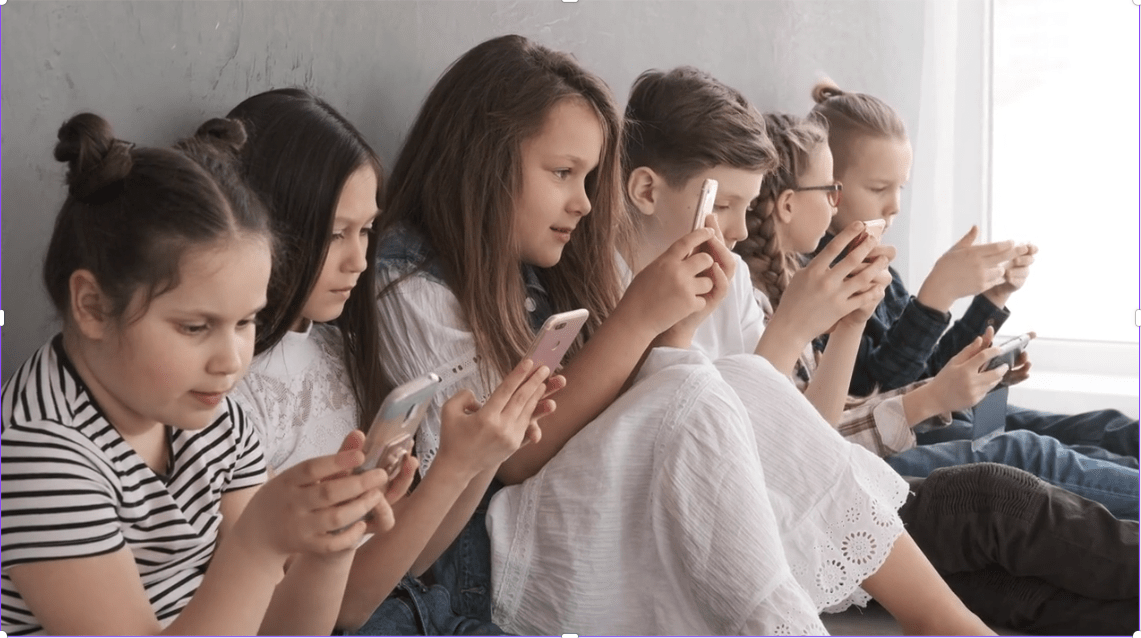
Children concentrating on mobiles
Bringing Back Face-to-Face
The interventions undertaken by All Saints Catholic College should be discussed, and possible elements or variations of the interventions, need to be considered countrywide. Recent events, like the pandemic and the economic downturn, have exacerbated the problem of children of all ages experiencing extended screen time, sometimes, as a form of distraction for their children.
This is borne out by a large study published by JAMA Pediatrics in 2023 which found that toddlers who had between 1-4 hours of screen time per day at age 1 were up to 3 times more likely to experience delays in fine motor, problem-solving, personal, and social skills by age 2, compared to those with less screen time. Those with 4+ hours per day were nearly 5 times more likely to have communication delays.[2]
Encouraging face-to-face interaction and eye contact, from an early age and continuing into adulthood, engenders confidence, helps children and adults express emotion, and creates vital connections in the brain and between people too. Encouraging students to engage in social and physical activities is one of the building blocks of a cohesive, healthy society. Games like table tennis, badminton, chess, and many others encourage a certain respect for one another and the discipline of taking turns or patiently waiting for the other person’s response to your move. These basic forms of self-discipline and gamesmanship are worth reintroducing into everyday life.
The concern voiced by O’Neill of potential ‘generational problems manifesting in workplaces and society’ is echoed by researchers and the government. However, educators need to heed the warnings from experience and what we see every day. Increasingly, television or computer screens are relied upon

Meet Fiona da Rocha, a trailblazer in education with over two decades of expertise. At the heart of her mission to transform early education, Fiona empowers parents and teachers to ignite a passion for learning in children aged 3-9. Her approach? Joyful, child-led experiences that build confidence and foster talent exploration. Discover how she’s making learning a thrilling adventure at FionaDaRocha.com-where education meets empowerment and enthusiasm.